
Our Philosophy
Northern Grove’s services are based on a foundational philosophy that tree care must consider the health of the tree as a whole, and the health of the surrounding ecosystem as well. When a tree is situated within a thriving ecosystem, it is given the best chance possible to thrive, to resist pests and disease, and to live long.
So how do we do that? How do we create or nurture a thriving ecosystem?
There are relatively simple actions we can take to benefit the ecosystems around us - mulch our trees and keep the soil covered, plant pollinator species, add water to a landscape.. But we would propose that to really help nature ‘sing’ requires us to rethink the very role of humanity on earth.
We were made to benefit the earth.
Humans can design their activities to heal the earth and meet human needs at the same time.

How is that possible? Aren’t humans innately damaging to the earth?
Most ecologically-minded property owners we work with are weighed down by the belief that humans need to damage the earth in order to meet their needs.
These folks wish it wasn’t true and do whatever they can to minimize the damage they cause. But they still struggle because they believe their very presence is a withdrawal from earth’s bank account – that when humans set up shop on a plot of land, it is good for the human and bad for the land.
What a tough position to be in, since this foundational belief puts us at odds with our natural surroundings, with the world that is our home. It suggests that it would be better if we didn’t ‘meddle’ with nature, and it would be even better if we just weren’t here at all.

Humans were meant for the earth like walnuts in maple ice cream.
When a tree exhales, we inhale. When we exhale, a tree inhales.
Humans are built to be a life-offering part of nature. We really, actually can’t help it.
When a tree exhales, we inhale. When we exhale, a tree inhales. In this way, the involuntary functions of our body give life to others, and are perfectly complimentary. This is true of other, less romantic bodily functions too, though society currently doesn’t see it this way.
Permaculture (a process of designing human activities to benefit both humans and the earth) suggests the same can be said of our voluntary activities – that our voluntary activities of building shelter, obtaining food and comfort, and creating societies can give life to the earth. If we adjust human activities to compliment the ways of nature. If we adapt our behavior so that we create a flow of give and take with the rest of nature.
If we do that, we can be as beneficial and healing a presence on earth as we have been damaging.
And maybe, finally, we can let go of the belief that it would be better if we weren’t here at all.
Humans are part of nature.


What is Permaculture?
Permaculture offers a way of creating “Consciously designed landscapes which mimic the patterns and relationships found in nature, while yielding an abundance of food, fibre and energy for provision of local needs.”
– David Holmgren, “Essence of Permaculture”
The term permaculture was coined by Bill Mollison & David Holmgren of Australia in the 1970s, referring to the process of designing permanently regenerative agriculture. The scope of permaculture has since expanded to include design of permanently regenerative culture.
Their work is drawn largely from their observations of how Indigenous peoples around the world have managed to live in harmony with nature.

Earth Care
Rebuild nature’s health and well-being

People Care
Nuture self, kin, and community

Fair Share
Use surplus responsibly
Permaculture Ethics and Principles
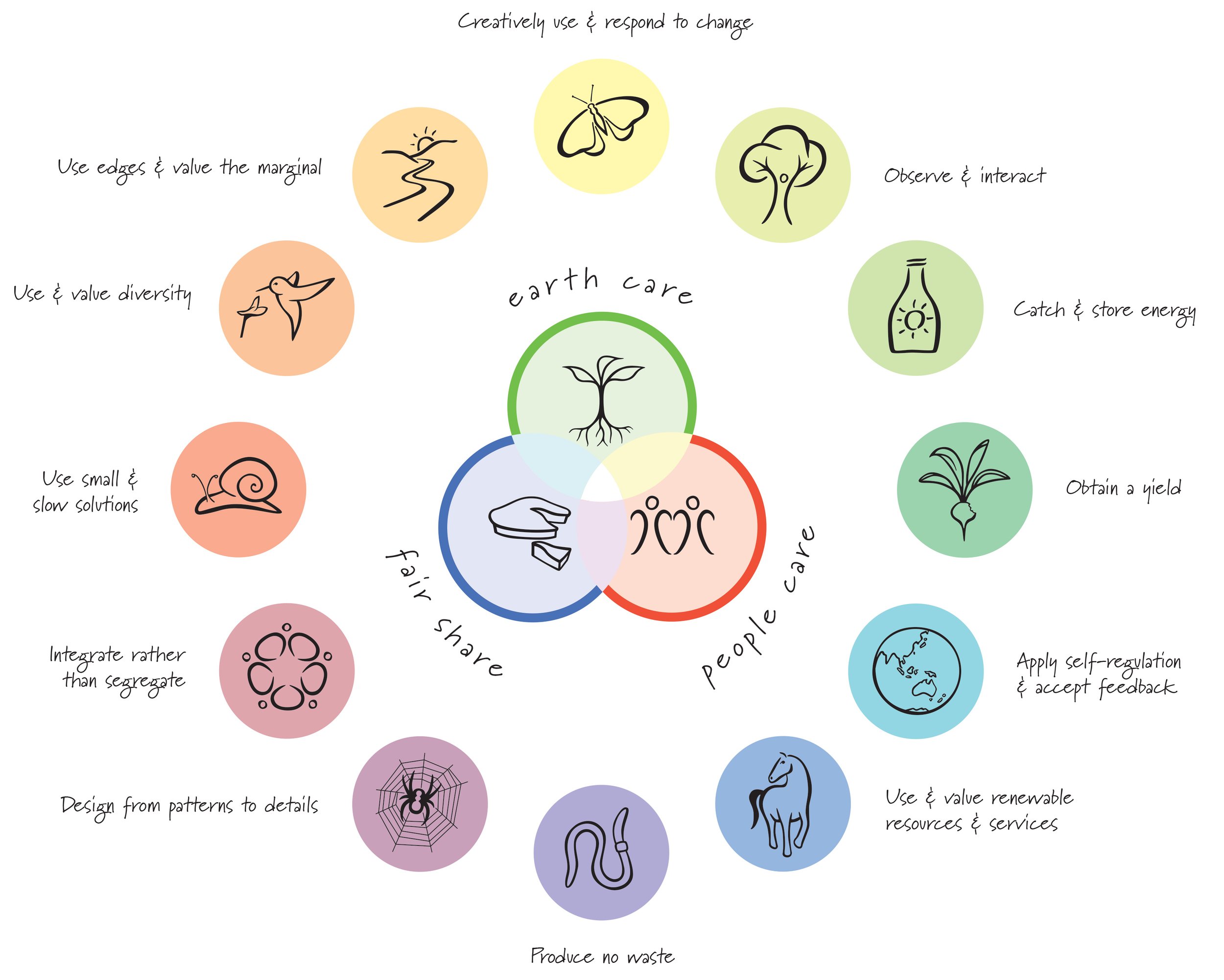
Three ethics form the foundation of permaculture:
Earth Care – rebuilding nature’s health and well-being;
People Care – taking care of ourselves, our families, and our communities; and
Fair Share – the responsible management of surplus.

Permaculture uses
12 Design Principles;
thinking tools that facilitate creative re-design of our environment and behaviour:
Observe and interact
Catch and store energy
Obtain a yield
Apply self-regulation and accept feedback
Use and value renewable resources and services
Produce no waste
Design from patterns to details
Integrate rather than segregate
Use small and slow solutions
Use and value diversity
Use edges and value the marginal
Creatively use and respond to change
Permaculture Principles
For a full discussion of permaculture ethics and principles, see David Holmgren’s free e-book, “Essence of Permaculture”
